
Business
What Is the Core Business Model? Examples and How to Choose One

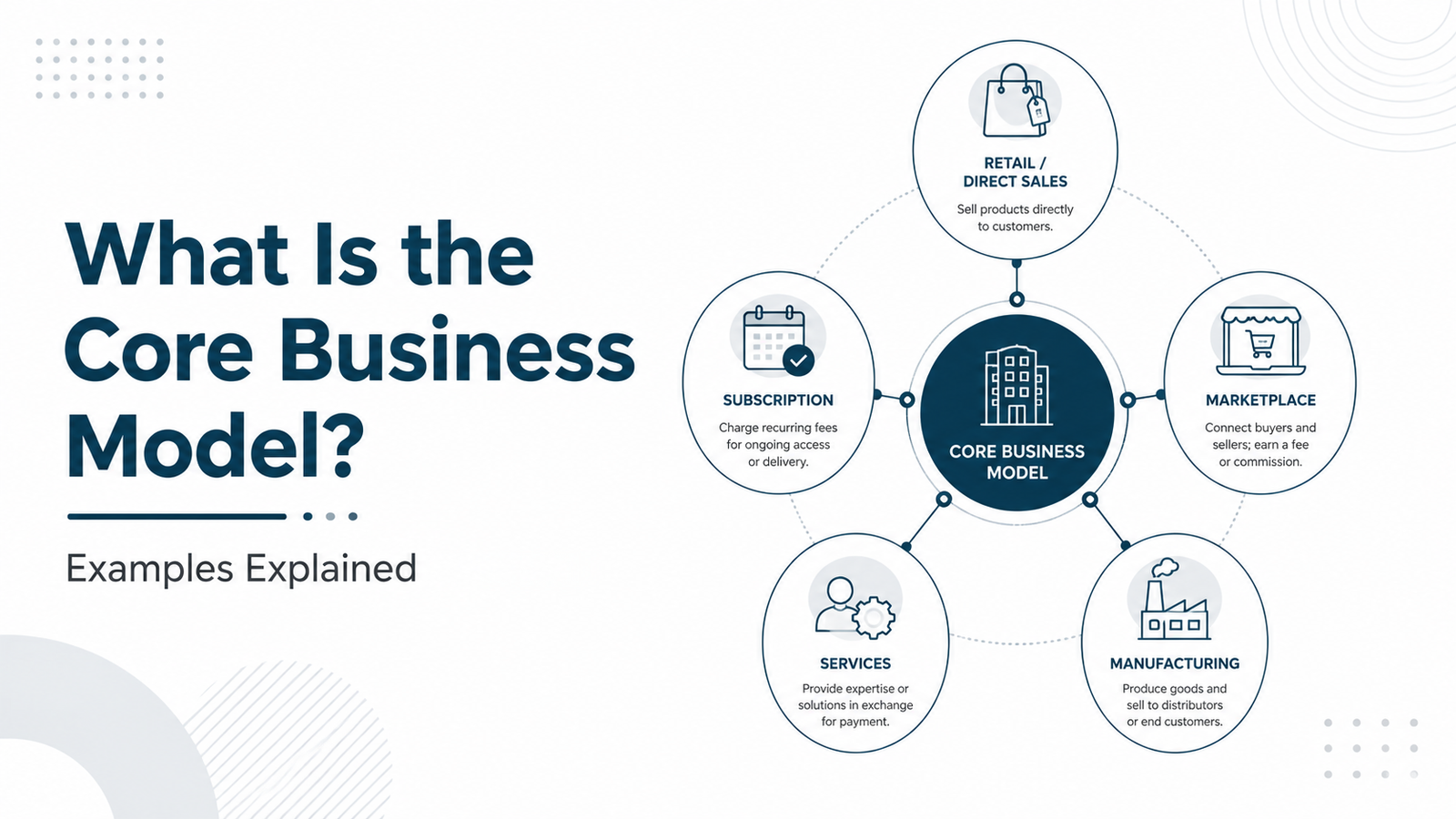
When planning a startup or reviewing an existing company, one of the first things to understand is how the business will actually operate.
A core business model lays out what a company does, who its customers are, how it delivers value and makes a profit. It’s the foundation that brings together all the key activities that let the business keep going and stay in the black.
Business models come in all shapes and sizes. Some companies sell tangible goods, while others provide services, charge regular fees, act as matchmakers between buyers and sellers, or line their pockets with ad revenue.
Looking at these different models can help you pinpoint one that fits with your market, product, and customers.
What Is a Core Business Model?
A core business model is the main system a company uses to create value for customers and generate revenue.
It explains the basic architecture of the business – the products or services it offers, the customers its after, how it gets its product to market, the main costs involved, and how it gets paid.
A core business model is more than just a revenue model.
A revenue model is all about how a company makes money, while a core business model explains everything from how the product gets made to how it’s delivered to customers and how the company competes in the market.
Take a software company for example, which might use a subscription revenue model. But its full business model also encompasses developing the software, hosting it online, getting customers on board, providing support, and making sure the product gets better with time.
Why a Core Business Model Matters
Having a great product is one thing, but it’s not enough to make a business a success. The company also needs to have a reliable way to get its product in front of customers, deliver it, manage its costs, and make enough cash to keep going.
A clear business model lets the founders figure out what they need to make it work and which customers to target. It also lets investors, employees, and partners in on the plan for growth. And without one, a business might be able to get some attention but struggle to turn that into long-term profits.
Core Business Model Examples
The right business model depends on the industry you’re in, how your customers behave, what you sell, what it costs to operate, and how much competition you have.
Here are some common models laid out to show how they work:
Manufacturer Business Model
A manufacturer creates physical products and sells them to wholesalers, retailers, other businesses, or individual customers.
Manufacturing companies manage product design, raw materials, production, quality control, and distribution.
Toyota and Samsung are examples of companies that rely heavily on manufacturing. They turn materials and components into finished vehicles, appliances, and electronics.
This model gives the company greater control over product quality and design. However, it can require large investments in factories, equipment, labor, inventory, and supply chains.
Retail Business Model
A retailer purchases products from manufacturers or wholesalers and sells them to consumers.
The business earns money by selling the product for more than it paid to obtain it.
Walmart, Costco, and Best Buy use retail models. They offer products from different brands through physical stores, websites, or both.
Retail companies must manage inventory, pricing, customer demand, suppliers, and distribution. Their success often depends on convenience, selection, competitive prices, and customer service.
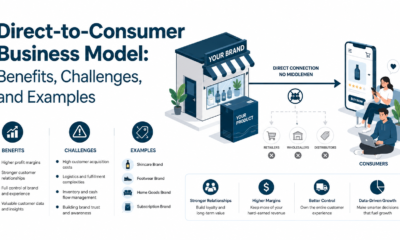
Direct-to-Consumer Business Model
A direct-to-consumer company sells products straight to customers instead of depending mainly on traditional retailers.
Many ecommerce brands use websites, social media, email, and digital advertising to reach buyers.
Warby Parker and Dollar Shave Club are familiar examples. By selling directly, these companies can control their brand, pricing, customer experience, and customer information.
The company must also manage shipping, returns, marketing, fulfillment, and support. This can make customer acquisition expensive, especially in competitive markets.
Service-Based Business Model
A service-based business earns revenue by providing labor, knowledge, skill, or professional support.
Examples include marketing agencies, consulting firms, repair businesses, accountants, lawyers, cleaning companies, and web developers.
The business may charge by the hour, by project, through a monthly retainer, or according to the results achieved.
Service companies often have lower startup costs than manufacturing businesses. However, they may struggle to scale because growth usually requires more employees, time, or specialized expertise.
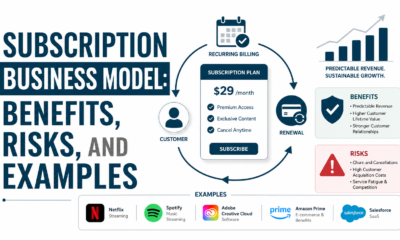
Subscription Business Model
A subscription business charges customers a recurring weekly, monthly, or annual fee.
Netflix, Spotify, and Microsoft 365 use subscription models. Customers continue paying as long as they want access to the product or service.
This model can provide predictable revenue and improve financial planning. It may also increase customer lifetime value when subscribers remain for long periods.
The main challenge is retention. Companies must continue improving the product, adding value, and giving customers a reason not to cancel.
Freemium Business Model
A freemium company offers a basic product for free and charges customers for additional features, higher limits, more storage, or advanced services.
Canva, Dropbox, and Zoom are examples.
The free version helps attract a large audience. A portion of those users may later move to a paid plan.
The challenge is deciding what to offer for free. If the free version is too limited, users may leave. If it provides too much, customers may have little reason to upgrade.
Marketplace Business Model
A marketplace connects buyers and sellers through a shared platform.
The company may not own the products or services being offered. Instead, it provides technology, payments, visibility, reviews, or transaction support.
Etsy connects shoppers with independent sellers. Airbnb connects travelers with property owners. Uber connects passengers with drivers.
Marketplaces usually make money through commissions, service charges, listing fees, subscriptions, or advertising.
This model depends on having enough users on both sides. Buyers need suitable sellers, while sellers need enough customer demand.
Advertising Business Model
An advertising-supported company builds an audience and charges advertisers to reach it.
Google, Facebook, YouTube, news publishers, and many mobile apps use advertising revenue.
Customers may use the service for free, while advertisers pay for exposure, clicks, leads, or sales.
This model works best when the company has a large audience or access to a valuable customer group. However, too many advertisements can damage trust and reduce the quality of the user experience.
Licensing Business Model
A licensing business allows another person or company to use its intellectual property in exchange for payment.
The licensed property may include software, technology, patents, trademarks, music, designs, characters, or branded content.
A software company may license its platform to business customers. An entertainment company may license characters to clothing or toy manufacturers.
Licensing allows the owner to earn revenue without producing every final product. Its value depends on owning technology, content, or branding that others want to use.
Franchise Business Model
A franchise allows independent operators to use an established company’s brand, products, systems, and operating methods.
McDonald’s, Subway, and many hotel chains use franchise models.
The franchise owner generally pays an initial fee and continuing royalties. In return, the parent company provides branding, training, marketing, processes, and support.
Franchising can help a business expand without paying the full cost of opening every location. However, the company must maintain consistent standards across all franchise locations.
Commission Business Model
A commission-based company earns a percentage or fixed fee from completed transactions.
Real estate agents, affiliate marketers, travel websites, payment platforms, and some marketplaces use this model.
For example, an online marketplace may receive a percentage from every sale made through its website.
Revenue increases when more transactions are completed. However, earnings may fall quickly when customer activity or transaction volume declines.
Razor-and-Blades Business Model
The razor-and-blades model involves selling an initial product at a low or reasonable price and earning repeat revenue from the items needed to keep using it.
Printers and ink cartridges are a common example. Coffee machines and capsules follow a similar approach.
The original product creates an ongoing relationship with the customer. The company then earns money from replacement parts, refills, or consumable supplies.
This model works well when customers continue using the same system for a long time.
How Companies Combine Business Models
Many major companies use more than one business model.
Amazon operates as a retailer, marketplace, subscription provider, cloud computing company, and advertising platform.
Apple sells physical products, offers subscriptions, operates digital marketplaces, and earns money from services and licensing.
A company may begin with one main model and add new revenue streams over time. These additional models should support the core business rather than create unnecessary complexity.
How to Choose the Right Business Model
Choosing a business model begins with understanding the customer problem.
Consider what customers need, how they currently solve the problem, and what they would be willing to pay for a better option.
The product type also matters. Physical goods may require manufacturing, wholesale, retail, or direct sales. Digital products may work better with subscriptions, licensing, advertising, or freemium access.
You should also examine operating costs. A business with high development or production costs may need recurring revenue, higher prices, or strong profit margins.
Competitor research can also be useful. It shows which models customers already understand and where existing companies may be failing to meet customer expectations.
Testing the Business Model
A business model should be tested before the company makes a major investment.
A startup may begin with a simple product, a limited service area, or a small group of customers. The goal is to discover whether people are interested and willing to pay.
Testing can reveal weaknesses in pricing, customer demand, delivery, or operating costs.
Some models attract many users but fail to produce enough revenue. Others generate sales but cost too much to operate.
Most successful business models are adjusted over time as the company learns more about its customers and market.
Conclusion
A core business model explains how a company creates value, serves customers, delivers its product, and earns revenue.
Manufacturing, retail, services, subscriptions, marketplaces, advertising, licensing, and franchising are among the most common examples.
The right choice depends on the customer, product, industry, costs, and long-term business goals.
Business model examples can provide useful inspiration, but the final model must work in real operating conditions. A strong model should be understandable, financially practical, and flexible enough to develop as the company grows.



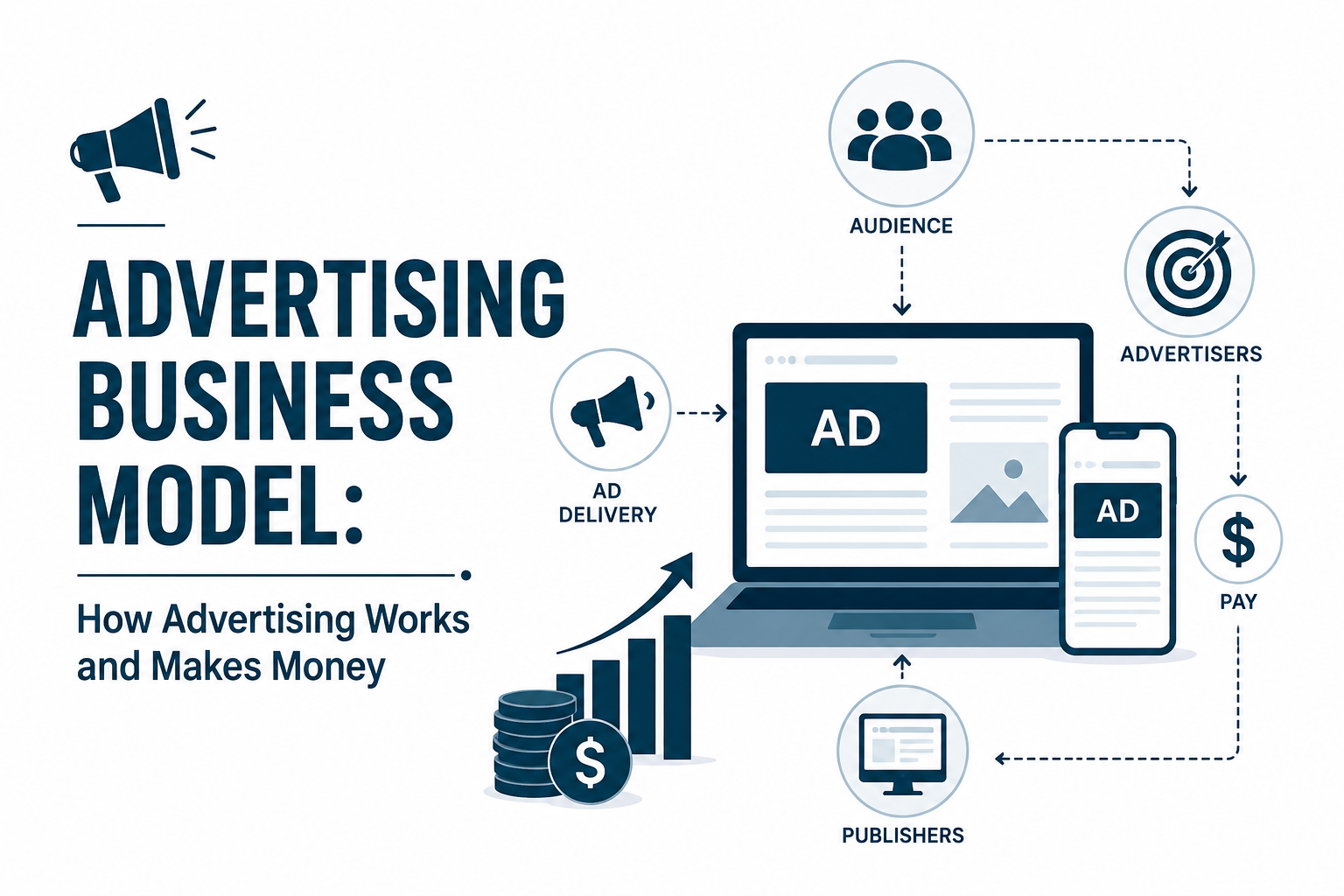
The advertising business model helps companies earn money by connecting advertisers with an audience. A website, app, TV network, search engine, social platform, or publisher provides space for ads. Brands then pay to place their message in front of people who may buy their products.
This model supports many of the largest online platforms. Google, Meta, YouTube, publishers, mobile apps, and streaming services all use advertising in different ways. Some depend mainly on ads, while others mix advertising with subscriptions or direct sales.
Modern advertising is also more measurable than traditional ads. Brands can track clicks, views, leads, purchases, and other actions. This data helps advertisers see which campaigns work and where they should spend their money.
What Is the Advertising Business Model?
An advertising business model is a system where a company earns revenue by selling access to an audience. The audience may visit a website, watch videos, use an app, read content, or search for information. Advertisers pay the platform or publisher to reach these users.
The company showing the ads may not sell anything directly to its audience. Instead, the audience creates value through its attention. A large and active audience can make advertising space more useful to brands.
This model appears across digital advertising, television, radio, newspapers, search engines, social media, podcasts, mobile apps, and outdoor media. The payment method can change, but the basic idea stays the same.
| Part of the Model | Main Role |
|---|---|
| Advertiser | Pays to promote a product or service |
| Publisher | Provides ad space |
| Audience | Views or interacts with the ad |
| Ad Platform | Connects advertisers with audiences |
| Data and Analytics | Measures ad results |
Main Types of Advertising Business Models
One common model is display advertising. Websites and apps place banners, images, native ads, or video ads within their content. Advertisers may pay based on impressions, clicks, or another agreed result.
Another model is search advertising. A business pays to appear near search results when users search for certain terms. Google Ads is a major example. Search ads can work well because the user already shows interest through the search query.
Social networks use another major form of the model. Platforms such as Facebook, Instagram, TikTok, and LinkedIn let advertisers choose audiences based on available targeting signals.
Common advertising models include:
- Display advertising for banners and visual ads
- Search advertising for keyword based ads
- Social media advertising for targeted campaigns
- Video advertising for online and streaming content
- Native advertising that matches surrounding content
- Sponsored content created with a brand
- Affiliate advertising based on sales or actions
Publishers may combine several of these models. This helps them avoid depending on only one source of revenue.
How Do Ads Actually Make Money?
Advertising makes money when an advertiser pays a publisher, platform, or media company to show an ad. The payment method depends on the campaign goal. Some brands want views, while others want clicks, leads, or sales.
A common method is CPM, or cost per thousand impressions. Under this system, an advertiser pays for every thousand times an ad appears. Large websites and video platforms often use impression based pricing.
Another method is CPC, or cost per click. The advertiser pays when someone clicks the ad. Search advertising often uses this method because a click can show clear customer interest.
Advertisers can also pay through CPA, which means cost per action, or CPL, which means cost per lead.
| Pricing Model | Meaning | Advertiser Pays When |
|---|---|---|
| CPM | Cost per thousand impressions | The ad receives 1,000 views |
| CPC | Cost per click | Someone clicks the ad |
| CPA | Cost per action | A user completes an action |
| CPL | Cost per lead | A new lead is generated |
| Fixed Fee | Set advertising price | Ad space is purchased |
| Commission | Percentage based payment | A sale takes place |
These models let businesses choose a payment system that matches their campaign goals.
How Advertising Platforms Create Value
An advertising platform needs both users and advertisers. Users provide attention. Advertisers provide revenue. The platform must create enough value for both groups.
For users, that value may come from free search, videos, news, entertainment, tools, or social features. Advertising can fund these services without forcing every user to buy a subscription.
For advertisers, the value comes from reach and measurable results. Strong platforms can provide:
- Audience targeting
- Conversion tracking
- Campaign analytics
- Budget controls
- Performance reports
- Automated bidding
- Ad testing tools
These features help businesses understand what happens after their ads appear. They can then improve campaigns based on real performance data.
First party data has also become more important. It can help businesses understand customers while using data collected directly from their own users and systems.
How to Start an Advertising Business?
The first step is choosing what type of advertising service you want to offer. You could start an advertising agency, build a niche website, run a media platform, manage paid ads, or sell local advertising space.
Next, choose a clear market. A small agency may focus on dentists, property companies, online stores, restaurants, or local service businesses. A publisher may create content for one niche and attract advertisers that want to reach those readers.
A simple process for starting an advertising business includes:
- Choose your advertising niche.
- Decide which services you will offer.
- Define your target customer.
- Choose a pricing model.
- Create contracts and payment terms.
- Build a basic website or portfolio.
- Find your first clients.
- Track and report campaign results.
You also need a clear pricing system. An agency may charge a monthly fee, project fee, percentage of ad spend, or performance fee.
As the business grows, tools for ad management, analytics, media buying, automation, and customer management can make the work easier.
Latest Advertising Trends
Artificial intelligence is one of the biggest advertising trends. AI tools can help brands create ads, study data, test campaigns, manage bids, and find useful audience patterns.
Video advertising also continues to grow. Social video, online video, connected TV, creator content, and streaming platforms give brands more ways to reach viewers.
Some major advertising trends include:
- Greater use of AI in advertising
- More spending on digital video
- Growth in connected TV
- Expansion of retail media
- More creator and influencer campaigns
- Stronger focus on first party data
- Better conversion and sales measurement
- More automated media buying
Commerce media is another growing area. Retailers can use customer and purchase data to help brands reach shoppers while they research or buy products.
Measurement is also changing. Advertisers want proof that campaigns create sales, leads, signups, or other business results. Simple impression counts are no longer enough for many brands.
What Are the Big 4 in Advertising?
The phrase Big 4 advertising companies can be confusing because the industry structure has changed. Older articles often listed WPP, Omnicom, Publicis Groupe, and Interpublic Group, also known as IPG.
Omnicom completed its acquisition of Interpublic Group in November 2025. This means IPG should no longer be treated as a separate group when discussing the current market.
A practical list of four major global advertising groups is:
| Advertising Group | Main Areas |
|---|---|
| Omnicom | Creative, media, data, commerce, branding |
| Publicis Groupe | Media, creative, digital, data, technology |
| WPP | Advertising, media, branding, commerce |
| dentsu | Media, customer experience, creative, digital |
These companies manage large global networks and work with major brands across many industries.
Other important groups also compete in advertising. Havas and Stagwell are examples. This means the term “Big 4” should be treated as a useful industry label rather than an official ranking.
Benefits of the Advertising Business Model
One major benefit of the advertising business model is that it can make content or services free for users. Search engines, social networks, news websites, and many apps can attract large audiences because users do not always need to pay.
The model can also scale well. A website that grows from ten thousand users to one million users creates far more advertising inventory.
Key benefits include:
- Access to a large potential audience
- Free or low cost services for users
- Scalable revenue for publishers
- Detailed performance tracking
- Multiple ad pricing models
- Strong targeting options
- Ability to combine ads with other revenue streams
The model can also work beside subscriptions, memberships, events, affiliate income, or direct product sales. This can help reduce dependence on one income source.
Advertisers also gain access to measurable results. Digital platforms can track impressions, clicks, leads, and conversions.
Risks and Challenges of Advertising
Advertising revenue can change quickly. Brands may cut spending during weak business periods. Publishers that depend only on ads can face problems when demand falls.
Competition is another challenge. Brands can choose between Google, social platforms, streaming services, retail media, publishers, creators, and many other channels.
Common challenges include:
- Heavy competition for ad budgets
- Privacy and data rules
- Ad blocking software
- Changes to tracking technology
- Rising advertising costs
- Low quality traffic
- Poor ad placement
- Too many ads on one page
Poor advertising can also hurt the user experience. Too many ads may make a website slow, confusing, or difficult to use.
Successful publishers need to balance revenue with trust. A good advertising system should support the content without making the audience want to leave.
Difference Between Advertising and Marketing
Marketing is the wider process used to understand customers and create demand. It includes market research, branding, pricing, product planning, customer experience, content, promotion, and distribution.
Advertising is one part of marketing. It focuses mainly on paid messages used to promote a company, service, product, or idea.
| Advertising | Marketing |
|---|---|
| Usually involves paid promotion | Covers the full customer strategy |
| Focuses on reaching an audience | Focuses on understanding and serving customers |
| Includes ads and sponsored placements | Includes research, pricing, branding, and sales support |
| Often has campaign based goals | Often has wider business goals |
| Is one part of marketing | Includes advertising as one activity |
For example, a company may first research customers and choose how to position a product. That work forms part of its marketing strategy.
The company may then use Google Ads, Instagram ads, YouTube ads, or television advertising to promote that product. Those paid campaigns fall under advertising.
Why Does the Advertising Business Model Remain Important?
Advertising still supports a large part of the media and internet economy. Businesses need ways to reach customers, while publishers and platforms need revenue to support their services.
The model also helps new companies gain attention. A small business can use search ads or social advertising without buying national television campaigns.
The basic relationship can be shown like this:
Advertiser → Ad Platform or Publisher → Audience → Customer Action → Revenue
Each part has a clear role. The advertiser pays for exposure. The platform provides access to users. The audience sees or interacts with the message.
The tools used in advertising continue to change. AI, streaming services, retail media, creators, privacy technology, and better measurement systems are shaping how campaigns work.
Yet the main idea stays simple. Businesses pay to reach people who may become customers. That exchange remains at the center of the advertising business model.
FAQs About the Advertising Business Model
What’s the Cheapest Form of Advertising?
The cheapest method depends on your business and audience. Organic social media, email, SEO, local listings, and useful content can require little direct ad spending. Paid search and social campaigns can also start with small budgets. However, the cheapest method is not always the most effective one.
Can I Run Ads Without Money?
You cannot normally buy paid advertising without a budget. However, you can promote a business without paying for media space. SEO, referrals, social posts, partnerships, community groups, and content marketing can attract customers without direct advertising spend. These methods still require time and work.
Do You Need an LLC to Run Ads?
No. You do not normally need an LLC just to run advertisements. Individuals and different types of businesses can buy ad space. However, business registration rules vary by country and location. A formal business structure may be useful if you run an agency, sign client contracts, hire staff, or manage large advertising budgets.
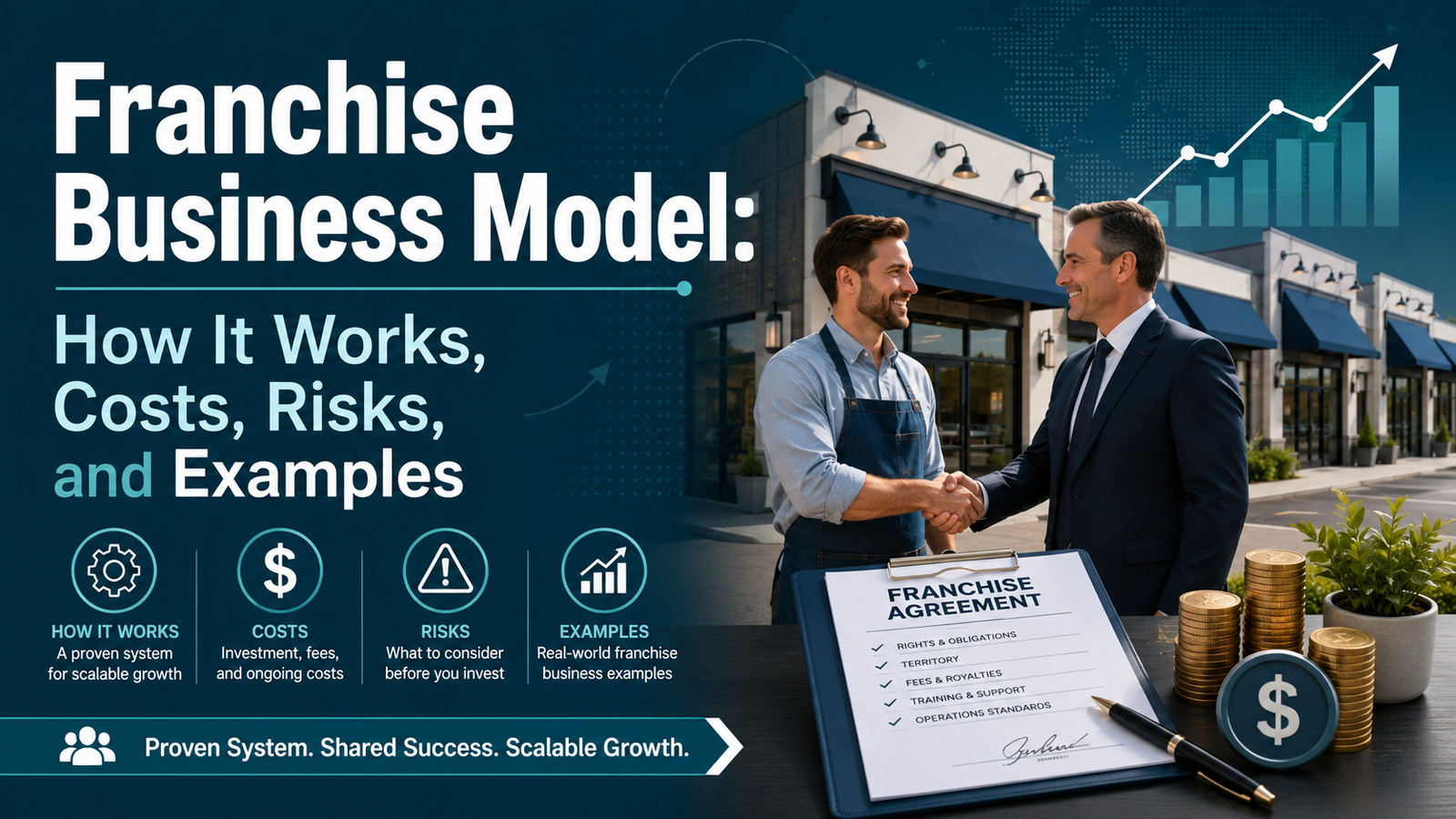
The franchise business model lets a company grow through local owners. The brand owner lets others use its name and system. Those owners follow set rules. They also pay agreed fees.
Franchising is common in food, hotels, retail, fitness, and home services. It can help a brand open more locations. It can also give a new owner a ready business system.
Still, a franchise does not promise profit. Owners face costs and business risks. A buyer should learn how the system works before signing a deal.
What Is the Franchise Business Model?
A franchise connects two separate businesses. The franchisor owns the brand and business system. The franchisee owns and runs a local business.
The U.S. Small Business Administration explains franchising in simple terms. A franchise owner gets the right to use a brand, logo, and business system. The owner may also get help from the franchisor.
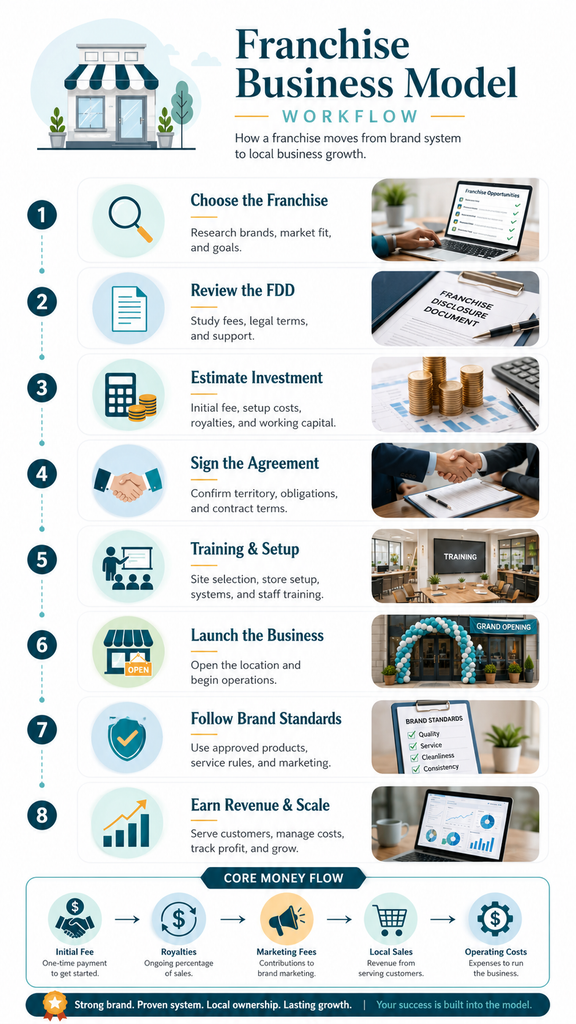
In return, the owner must follow brand rules. The owner may also need to buy approved goods or services. These duties depend on the franchise agreement.
Under U.S. federal rules, a business may count as a franchise when three parts are present. The buyer uses the brand. The franchisor gives control or major help. The buyer also makes a required payment.
The franchise business model is more than a basic brand licence. It creates an ongoing business link. Both sides have clear duties.
| Party | Main Role | Common Duties |
|---|---|---|
| Franchisor | Owns the brand and system | Training, support, marketing, and brand rules |
| Franchisee | Runs the local business | Staff, sales, service, costs, and daily work |
| Customer | Buys from the local unit | Receives the product or service |
How Does the Franchise Business Model Work?
The process often starts with an application. The franchisor reviews the buyer. The buyer also studies the franchise offer.
Both sides look at fees, rules, territory, and support. They also review the main contract. If they agree, they sign a franchise agreement.
In the United States, the Federal Trade Commission enforces the Franchise Rule. A franchisor must usually give the buyer a Franchise Disclosure Document. This document is also called an FDD.
The buyer must normally get the FDD at least 14 calendar days before signing or paying the franchisor. This gives the buyer time to review the offer.
The FDD has 23 required items. They cover fees, legal issues, contracts, support, and other facts. Buyers can use this data to study the business.
After signing, the owner prepares the location. The franchisor may give training and work guides. It may also provide marketing tools and supplier rules.
The franchise business model needs consistency. Customers expect a similar experience at each location. For this reason, brands often use clear rules.
Main Types of Franchising
The Small Business Administration describes two common forms of franchising. The first is product and trade name franchising.
This type gives an owner the right to sell goods under a brand. The franchisor may make or supply those goods. The local owner then sells them.
This model often focuses on products and sales. It may not include a full business system. The exact terms depend on the agreement.
The second form is business format franchising. This type is common in restaurants and service firms. It gives the owner a wider system.
The system may include training, marketing, store design, site help, and work methods. The owner gets more support. But the owner must also follow more rules.
Franchise Costs and Revenue
A franchise can have many starting costs. The buyer may pay an initial franchise fee. Other costs may include rent, equipment, stock, licences, and insurance.
Some systems charge for training or setup. The owner may also need cash for wages and early bills. These costs can add up fast.
Many franchisors also charge ongoing royalties. These fees are often based on sales. Some brands also charge marketing or software fees.
Other charges may cover renewal, supplies, or special services. Buyers should know each fee before they sign.
The FTC points buyers to FDD Items 5 through 7. These sections explain initial fees, other fees, and expected startup costs.
The franchisor can earn money in several ways. It may earn from fees, royalties, rent, or supplies. The contract explains how these payments work.
The franchisee earns money from local sales. But sales are not the same as profit. The owner must first pay all business costs.
This money flow is a key part of the franchise business model. Strong sales can still lead to low profit. Rent, wages, debt, and fees can cut the final return.
Pros and Cons of the Franchise Model
A franchise can give an owner a known brand. This may make it easier to attract customers. The owner also gets an existing system.
Many brands offer training before opening. Some give help with marketing and store design. Others may help with suppliers or site choice.
This support can save time. It may also help a new owner avoid some early mistakes. Yet the amount of support can vary.
Franchising can also help the brand owner grow. Local owners provide much of the money needed for new locations. The franchisor can focus on the wider system.
But franchise owners give up some freedom. They cannot always change products or services. They may also face rules about signs, suppliers, and store design.
Some brands control prices or promotions as well. Owners who want full control may find these rules hard to accept.
| Possible Benefits | Possible Limits |
|---|---|
| Known brand | Less freedom |
| Training and support | Initial and ongoing fees |
| Shared marketing | Strict rules |
| Existing systems | Brand problems can hurt local stores |
| Supplier network | Transfer rules may apply |
What Are the Risks of Owning a Franchise?
Money is one of the main risks. A buyer may spend a large amount before opening. Bills still continue when sales are weak.
A second risk is limited control. The franchisor may set rules for products and suppliers. It may also control design, software, and service.
This system may work well for some owners. Others may want more freedom. Buyers should think about this before they invest.
The contract can also create risk. FDD Item 17 covers renewal and transfer rules. It also covers ending the deal and dispute terms.
Buyers should read these terms with care. A lawyer can help explain them. This can prevent problems later.
Brand problems can also affect local stores. A public issue at one location can hurt trust in the whole chain. A local owner may have little control over this.
A franchise may lower some startup uncertainty. But it does not remove business risk. A franchise can still lose money or close.
Why Do Franchises Fail?
A franchise can fail when sales stay too low. The owner still has to pay bills. These bills may include rent, wages, debt, supplies, and fees.
Low sales can quickly hurt cash flow. This can make it hard to keep the business open.
Location can also affect results. A poor site may have too few customers. Weak demand can cause the same problem.
High debt can make these issues worse. The owner may have large monthly payments. This leaves less room for slow periods.
The owner may also be a poor fit for franchising. Some people work well with clear rules. Others prefer to make their own choices.
Weak support can also hurt the business. Training, software, supplies, and field support all matter. Buyers should check what support the brand really gives.
The FDD can help buyers spot warning signs. Item 20 gives data about locations and owner turnover. Buyers can also speak with current franchisees.
Former franchisees may also give useful views. They can explain why they left the system.
Successful Franchise Business Model Examples
Large franchise systems show how this model can support growth. But their size does not promise profit for each owner.
Local results still depend on sales, costs, location, and management. Each store faces its own business conditions.
McDonald’s is one major example. At the end of 2025, it had 45,356 restaurants around the world. About 95 percent were franchised.
Yum! Brands also uses franchising on a large scale. Its brands include KFC, Taco Bell, Pizza Hut, and The Habit Burger & Grill.
In a 2026 filing, Yum! Brands said franchisees ran 97 percent of its restaurants.
Domino’s also relies on franchise owners. Its 2025 annual report listed 6,924 U.S. franchise stores. It also listed 14,956 international stores.
Marriott International uses franchised and licensed hotels in many countries. This shows that the franchise business model is not limited to food.
It can also work in hotels, retail, fitness, and many service fields.
These brands show how large a franchise network can become. They do not prove that every local owner will make money.
How to Check a Franchise Before Buying
Start with the FDD. Do not depend only on a sales pitch. Read the document with care.
Check the fees first. Then review the legal history and support terms. You should also study the contract rules.
Pay close attention to Item 19. This item covers financial performance representations.
A franchisor does not have to make an earnings claim. If it does make one, the claim must follow FTC rules.
The claim should have a reasonable factual basis. Buyers should compare those figures with their own expected costs.
Item 20 is also useful. It shows changes in the franchise network. It can help buyers find current and former owners.
Speak with those owners when possible. Ask about training, costs, staff, support, and daily work.
Ask what surprised them after opening. Also ask whether costs matched the information they received.
A lawyer can review the agreement. An accountant can check the numbers.
These steps matter because the franchise business model creates a long business relationship. It also creates legal and money duties.
Franchise Compared With an Independent Business
A franchise may suit a person who wants a set system. It may also suit someone who values training and brand support.
The owner does not have to build every process from zero. But the owner must follow the brand’s rules.
An independent business gives the owner more freedom. The owner chooses the name and products. The owner can also set work methods.
But this freedom brings more work. The owner must build the business system. The owner must also build the brand.
Both choices have risks. The better choice depends on the buyer’s goals and skills.
Money also matters. So does the amount of control the owner wants.
A famous brand should not be the only reason to buy. Buyers should study the real costs and duties first.
Final Thoughts
The franchise business model links local ownership with a shared brand. It gives owners access to an existing name and system.
Many franchisees also get training and support. This can make starting a business easier.
But the model also has limits. Owners must pay fees and follow rules. They also take on normal business risks.
A buyer should read the FDD before making a choice. Speaking with current and former franchisees can also help.
Legal and financial advice can add another layer of protection. Good research helps buyers understand the full deal.
A strong brand can help a business. But careful planning matters more than a famous logo.
FAQs
Is owning a franchise good money?
A franchise can make money, but profit is never certain. Results depend on sales, costs, fees, debt, location, and management. Buyers should study valid Item 19 data before investing.
What is the highest paying franchise to own?
There is no single verified franchise that always pays the most. Results change by brand and location. Costs and owner performance also matter. Buyers should use supported FDD data instead of online income claims.
What is the difference between a franchise and a licence?
A licence often gives permission to use certain property. This may include a name or trademark. A franchise often adds a wider business system, support, control, and required payments.
Can a franchise owner sell the business?
In many cases, yes. But the franchise agreement may set rules for a sale. The franchisor may need to approve the new buyer. Transfer fees may also apply.
Does the franchise business model reduce business risk?
The franchise business model may reduce some startup uncertainty. The owner gets an existing brand and system. But it does not remove the risk of loss or closure.
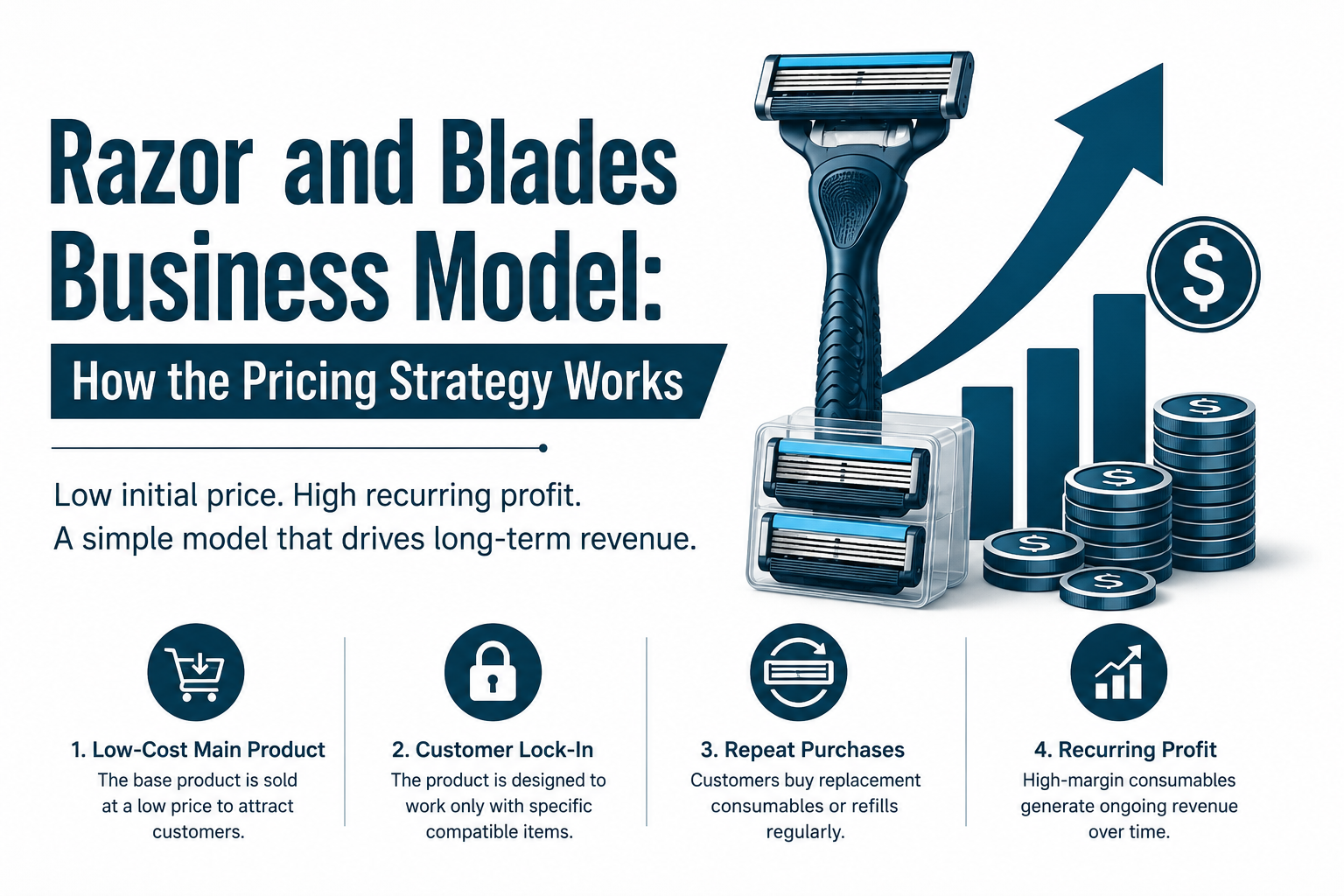
Selling a product once is useful. Selling something to the same customer again and again can be far more valuable.
That idea sits at the heart of the razor and blades business model. A company makes its main product easy or affordable to buy. The customer then needs replacement items, refills, content, or other products that work with it.
Razors and replacement blades gave the strategy its famous name. But the same idea can be seen in printers, coffee machines, game consoles, and some digital products.
The model sounds simple. In practice, it depends on pricing, repeat purchases, product compatibility, and customer loyalty.
What Is Razor Blade Strategy?
The razor blade strategy is a business model where a company sells a main product at a relatively low price and earns more money from products that customers need afterward.
Think of a razor handle.
Buying the handle gets the customer into the system. Once that happens, the person needs replacement blades. Those blades may be purchased many times during the life of the handle.
The first product is sometimes called the base product, while the repeat-purchase item is called the consumable.
A company does not always need to lose money on the base product. That is a common misunderstanding. It may sell the base product at cost, at a small profit, or simply at a lower margin than the consumables.
The real goal is the same: to create a long-term customer rather than depend on a single transaction.
The history of Gillette also deserves some nuance. The company is closely linked with this business model, but historical research shows that King C. Gillette did not simply build his early business by selling razor handles below cost. The textbook version is cleaner than the actual history.
How the Razor and Blades Model Operates
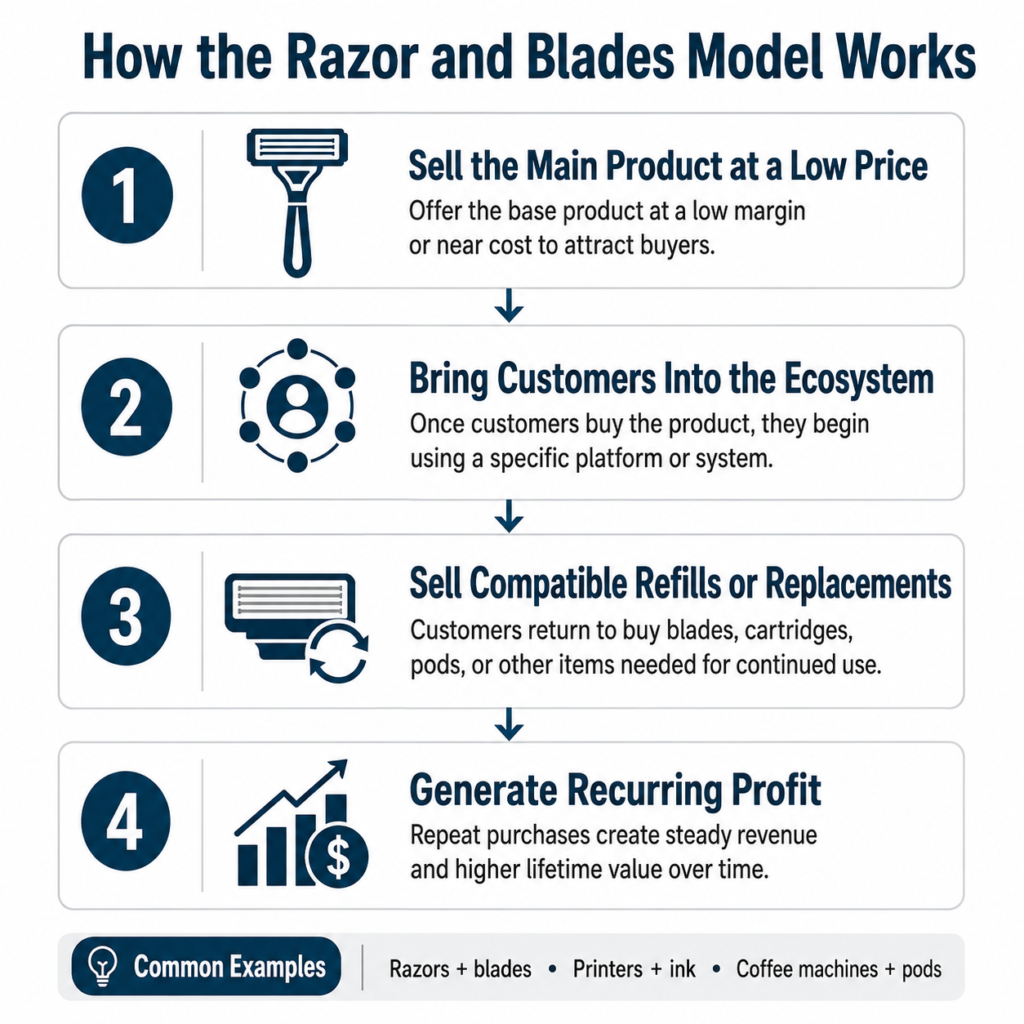
The razor and blades business model normally begins with a product that acts as an entry point.
A customer might buy a printer, coffee machine, razor handle, or game console. The initial purchase gives the company access to future spending.
Then comes the second part.
The customer needs ink, coffee pods, blades, games, accessories, or another compatible product to keep using the original item.
Suppose a company sells a device for $50 and makes only $5 from that sale. The customer then spends $15 every two months on replacement supplies.
After two years, those follow-up purchases may be worth far more than the original $5 profit.
This changes how the business views a sale.
The first purchase is not necessarily the finish line. It is the start of the customer relationship.
What Is the Pricing Strategy of Razor and Blades?
Pricing is what makes this model work.
The base product is usually priced to reduce the customer’s hesitation. It needs to be affordable enough to attract people into the product system.
The consumable can carry a higher margin because the customer already owns the main product.
There are several ways companies can structure this.
Some sell the base product at a loss. Others make a small margin. Many simply accept lower margins on hardware because they expect repeat purchases later.
The company therefore pays close attention to customer lifetime value rather than profit from the first transaction alone.
For example, a printer may look inexpensive on a store shelf. But the cost of ink over several years may exceed the original purchase price.
HP’s own 2026 cost comparison shows how different these economics can be. It estimates much lower per-page costs for refillable Smart Tank printers than for its standard cartridge-based printers, illustrating how the cost of consumables can reshape the total price of ownership.
Why Companies Use This Business Model
Recurring revenue is the obvious attraction.
A business that only sells one-time products must keep finding new customers. A company using the razor and blades business model can earn revenue from people who have already purchased its main product.
That can make sales more predictable.
It can also increase customer lifetime value. One customer may make dozens of small purchases over several years.
Compatibility can strengthen the effect.
If a certain blade only fits a certain razor, switching brands may mean buying another handle. The same issue can appear with coffee systems, printers, software, and other products.
That creates what economists and business strategists call switching costs.
The customer can leave. But leaving has a price.
Real-World Examples
The strategy has moved far beyond shaving products.
Gillette Razors and Replacement Blades
Gillette remains the example most people connect with this model.
A customer buys a reusable razor handle and then buys compatible replacement cartridges as the old blades become dull.
The repeat purchase matters because one handle can lead to years of blade sales.
Competition can still weaken the system.
Brands such as Dollar Shave Club challenged traditional razor pricing by selling shaving products directly to customers online. Strategyzer notes that Dollar Shave Club entered the market in 2012 with lower-priced products and a direct-to-consumer approach.
Gillette eventually responded to growing price pressure. A Harvard Business School case notes that the company announced price cuts on razors and blades in April 2017 after losing share to lower-cost competitors such as Dollar Shave Club and Harry’s.
Printers and Ink Cartridges
Printers provide another clear example.
The printer is the base product. Ink or toner creates repeat sales.
Customers need new supplies as long as they keep using the machine.
Compatibility becomes very important here. Printer companies design cartridges for specific printer families and often hold patents on chips, software, and other technologies related to their supply systems.
In 2026, HP said protecting its cartridge-related intellectual property remained a major part of its print supplies business.
Keurig Machines and K-Cup Pods
Keurig offers another useful case.
Customers buy a brewing machine and then continue purchasing compatible beverage pods.
For years, intellectual property helped protect parts of the K-Cup system.
Two U.S. patents associated with K-Cup packs expired in September 2012. Keurig’s regulatory filings later acknowledged that third parties had launched competing compatible products and that competition from unlicensed brands had increased.
That case shows both the strength and weakness of the model.
Compatibility can protect profits. Once competitors can legally offer compatible alternatives, the original supplier may face much more price pressure.
Amazon Kindle and Digital Books
The strategy can also work without a physical consumable.
Amazon Kindle is a good example.
The Kindle gives people a device for reading digital books. After buying the device, users can continue purchasing ebooks through Amazon.
Harvard Business Review has described Kindle as a classic example of the razor-and-blade approach, where the hardware supports future content sales.
The “blade” in this case is digital.
No metal required.
Advantages of the Razor and Blades Business Model
The biggest advantage is repeat business.
Once the company has a large installed base of customers, every active product can create future demand.
Revenue can also become easier to forecast. A business may estimate how often customers replace blades, cartridges, pods, or other supplies.
The model may also support aggressive pricing on the first product.
A company can accept a lower margin on hardware because it expects to earn more from the customer later.
Brand loyalty can become stronger too. If the products work well together, customers may prefer buying the familiar compatible option rather than experimenting with another system.
Done well, the model turns one product sale into a series of transactions.
Risks and Weaknesses
The razor and blades business model is not guaranteed to work.
Competition is one major threat.
If another company produces a compatible consumable for less money, customers may stop buying the original version.
Patents can delay this problem, but patents expire.
Keurig’s experience after its 2012 K-Cup patent expirations shows what can happen when more compatible alternatives enter the market.
Customers can also become annoyed by high replacement costs.
A cheap base product may stop looking cheap once buyers calculate what they spend on refills over several years.
New technology creates another risk.
Refillable ink tanks, reusable coffee pods, subscription services, and competing product standards can weaken an established system.
So the company cannot depend on lock-in alone. The consumable still needs to offer enough value for customers to keep buying it.
The Reverse Razor and Blade Model Strategy
The reverse razor and blade business model flips the traditional approach.
Instead of selling the main product cheaply and earning large margins from related products, the company makes strong profits from the main product while using related goods or services to increase its value.
A premium technology ecosystem can work this way.
The company may charge a high price for the hardware instead of treating it as a low-margin customer acquisition tool.
Apple is often useful for understanding the contrast. Apple makes significant margins from its devices rather than depending on selling the hardware cheaply. Its software, services, accessories, and app ecosystem then add more value around those devices. Strategyzer describes Apple’s approach as centered on premium device pricing and strong hardware margins.
So the difference comes down to where the main profit sits.
In the traditional model, later purchases often carry the better economics.
In the reverse model, the main product itself can be highly profitable.
Razor and Blades Model vs. Freemium Model
These two strategies share an idea, but they are not identical.
The razor and blades business model normally depends on one product creating demand for another related product.
A razor leads to blade purchases. A coffee machine leads to pods. A printer leads to ink.
Freemium model works differently.
A company gives customers a basic product or service for free. Some users later pay for extra storage, advanced tools, premium features, fewer restrictions, or another upgraded service.
The free version is designed to attract a large user base.
Only part of that user base needs to become paying customers.
Both models reduce the barrier to getting started. But the source of future revenue is different.
What Makes the Model Successful?
Cheap hardware alone is not enough.
The company needs customers who actually use the product and continue buying supplies.
Consumables must also have reasonable purchase frequency. A replacement product bought once every ten years will not generate much recurring revenue.
Customer retention matters just as much.
And the economics must survive competition.
A company should understand its acquisition cost, average refill frequency, gross margin, customer lifetime value, and likely churn before relying on the model.
Without those numbers, selling the first product cheaply can simply mean selling something cheaply.
No clever business model can rescue bad math.
Conclusion
The razor and blades business model turns a one-time product sale into an opportunity for recurring revenue.
The company attracts customers through a base product. It then earns ongoing income from blades, refills, cartridges, pods, digital content, or other related purchases.
Gillette made the idea famous, but the strategy now appears in many industries.
Its strength comes from repeat buying and switching costs. Its weakness comes from the same place. If customers find cheaper compatible products or decide the ongoing cost is too high, the advantage can disappear quickly.
The best versions of the model do more than trap customers inside a product system. They give customers enough convenience, quality, or value to make staying worthwhile.
FAQs
How does Gillette make money?
Gillette sells razor handles, disposable razors, replacement blade cartridges, shaving products, and other personal-care goods. Replacement blades are especially important because customers who own compatible handles can purchase cartridges repeatedly. Gillette’s business is part of Procter & Gamble.
Why is it called the razor and blades business model?
The name comes from the relationship between a reusable razor and its replacement blades. The customer buys the main product first and then continues buying consumable products needed to use it.
Does the company always lose money on the razor?
No. A company does not have to sell the main product below cost. It may make a small profit or simply use a lower margin on the base product while earning stronger margins from repeat purchases.
What businesses use the razor blade strategy?
Common examples include shaving products, printers and ink, coffee machines and pods, some game consoles and games, and hardware connected with digital content.
What is the biggest risk of the razor and blades model?
Competition from cheaper compatible products is one of the biggest risks. Patent expiration, changing technology, customer frustration over refill prices, and low switching costs can also weaken the strategy.
What is the reverse razor and blade model?
The reverse model puts more profit into the main product rather than the consumable. A business may sell premium hardware at a strong margin while using related services, software, accessories, or content to make that hardware more valuable.

Mike Lindell Net Worth, Height, Wife, Age and Business Career

Advertising Business Model: How Advertising Works and Makes Money

Franchise Business Model: How It Works, Costs, Benefits, Risks, and Examples

What Is a Business Model Canvas? The 9 Building Blocks Explained

14 Business Model Types: Examples and Revenue Logic

What Is the Core Business Model? Examples and How to Choose One
-
 Business2 months ago
What Is a Business Model Canvas? The 9 Building Blocks Explained
-
 Business2 months ago
14 Business Model Types: Examples and Revenue Logic
-
 Business2 months ago
The Marketplace Business Model: Blueprint for Scale
-
 Business2 months ago
Freemium Business Model: How Free Users Become Paying Customers
-
 Business2 months ago
What Is a Revenue Model? Types, Examples, and How It Works
-
 Business2 months ago
What Is a Subscription Business Model and How Does It Work?
-
 Business2 months ago
Direct-to-Consumer Business Model: Benefits, Challenges, and Examples
-
 Business2 months ago
B2B Business Model: Types, Benefits, Challenges, and Examples